Best SendGrid alternatives: 7 options for marketing and transactional email
SendGrid is one of the biggest names in transactional email, but it's not ideal for everyone. The loss of a free plan sent smaller-scale senders looking elsewhere and it's not the perfect fit for businesses who want to unify their marketing and transactional emails into one, cost-effective platform. So what else is out there?
Let’s start with the obvious, SendGrid alternatives are email platforms that do the same jobs: transactional email through an API or SMTP relay, marketing campaigns, or both. SendGrid has two main products. SendGrid Email API for sending transactional emails and Twilio SendGrid Marketing Campaigns for sending – you guessed it – marketing emails.
Now that SendGrid is part of Twilio, its email products sit within a much larger communications suite. But we’re not here to analyze that. We want to know whether SendGrid is still a smart choice as an email platform and what other options there are.
Ultimately the right alternative depends on what you intend to use SendGrid for. A team sending nothing but password resets will want something very different from a team running campaigns and transactional email side by side. This page covers both.
What to look for in a SendGrid alternative
Not every feature or functionality matters for everyone. Work out which of these apply to you before comparing SendGrid competitors line by line.
Scope. Do you need transactional email, marketing campaigns, or both from one platform? This is the question that narrows the list fastest.
Pricing model. Some platforms charge for the emails you send. Others charge for the contacts you store, or both.
Deliverability. How many of your emails actually arrive. Look for dedicated IP options, reputation monitoring, and authentication support.
Features. Marketing teams need an email editor, AI content tools, automations, and segmentation. Developer teams need an API, SMTP relay, and webhooks.
Ease of use. Developers want clear documentation, while marketers want to create HTML emails and automations without engineering help.
Support access. Check which plan tier includes real support, not just documentation.
Data location. Where your subscriber data is stored matters if you operate in the EU or serve EU customers.
SendGrid is best known as a transactional email platform, but it caters for marketers too. The seven options below deliberately mix both kinds of platform. Some handle marketing and transactional email together, and some are transactional specialists, because the right answer changes depending on which you need.
Why deliverability matters
Sending an email means nothing if no one receives it. Deliverability is the share of your emails that reach an inbox rather than a spam folder.
And it is getting harder. Gmail and Yahoo tightened their bulk sender requirements in 2024, and authentication through SPF, DKIM, and DMARC is now effectively mandatory rather than good practice. Weak deliverability tooling costs you revenue quietly, because the emails leave and nobody tells you they never landed.
Ask what a provider does about email validations, reputation monitoring, authentication setup, and dedicated IPs before you ask what it charges.
The 7 SendGrid alternatives at a glance
Here is how the seven options compare across the things most teams weigh first.
Platform
Best for
Marketing email
Transactional email
Free plan
Pricing based on
Mailjet
Marketing and transactional in one platform
Yes
Yes
6,000 emails/mo
Contacts and emails
Mailgun
High-volume transactional infrastructure
No
Yes
100 emails/day
Emails sent
Resend
Fast setup
Yes
Yes
3,000 emails/mo
Contacts and emails
Postmark
Transactional-only senders
No
Yes
100 emails/mo
Emails sent
Amazon SES
Lowest cost at very high volume
No
Yes
Free for 6 months
Emails sent
Brevo
Combined marketing and sales tools
Yes
Yes
300 emails/day
Contacts and emails
MailerSend
Developer tooling depth
No
Yes
500 emails/mo
Emails sent
When you dig into pricing, you’ll find that platforms that only offer transactional email appear cheaper. But the catch is when you need to pay for two platforms to cover both transactional and marketing.
For example, Resend’s transactional plans charge per email sent, starting at $20/month for 50,000 email sends. But for marketing emails, they charge per contact and it costs $40/month to send to 5,000 contacts. Together that’s $60/month.
Only three of the seven cover marketing and transactional email properly. If you need both, that is where your shortlist starts.
Why teams are leaving SendGrid
The most common reason right now is pricing structure, not price. Four changes drive most of the discontent.
The free plan is gone
SendGrid retired its free Email API and free Marketing Campaigns plans in 2025, with a 60 day transition window. According to SendGrid’s own changelog, email sending was paused for accounts on all free plans once that window closed. There is no permanent free tier now, only a 60 day trial.
Marketing emails are priced on audience, not email volume
SendGrid’s Marketing Campaigns pricing is determined by monthly contact storage, email volume, and features. Basic starts at $15 a month for 15,000 emails and 5,000 contacts. Advanced starts at $60 a month for 50,000 emails and 10,000 contacts. Grow your audience and your bill keeps increasing, even if you don’t send emails to all of that audience.
Account access and confusing developer documentation
There is a third reason that shows up constantly in developer discussions: Account access. Locked accounts, failed two-factor authentication, and suspensions triggered by an IP change come up repeatedly, while support resolution is slow. Verification friction exists across this whole category, but it is a common complaint for SendGrid users in particular.
The pattern shows up in reviews too. A supply chain manager rates SendGrid three out of five on G2. They praise a “solid and scalable API connectivity tool,” then fault documentation that is “often guessing game.”
Mixed impact of the Twilio acquisition
SendGrid’s acquisition by Twilio has pros and cons. It means that email now sits inside a much larger platform. Twilio sells SMS, voice, verification, and customer data alongside email. That helps if you want those channels from one vendor.
But it works against you if you want an email specialist, because email competes for roadmap attention with everything else. Email API and Marketing Campaigns are priced independently, on different models. A team that needs both buys two products and reconciles two bills.
If you are looking to replace SendGrid, the seven platforms below each answer a different part of that picture.
Our pick of the best alternatives to SendGrid
Best for marketing and transactional in one platform: Mailjet
Mailjet runs marketing campaigns and transactional email on one platform, on one plan. For a team currently paying for SendGrid’s Email API alongside Marketing Campaigns, that is two products and two bills becoming one.
It is built for marketers and developers working in the same place, which is where the all-in-one part actually matters. Marketers get a drag-and-drop email editor, AI tools that speed up content creation, automations, segmentation, landing pages, and signup forms. Developers get a send API, SMTP relay, webhooks, and real-time collaboration on templates through MJML. Neither side waits on the other to ship a campaign.
On pricing, contacts are unlimited from the Essential plan upward, so your audience can grow as you scale without changing what you pay. Sending volume is what moves the bill.
Outdooractive runs both sides at scale. That means 3.5 million personalized emails a week and over 300 million a year, across four languages, at a delivery rate above 96%. Smaller teams get the same structure. TYPO3 uses it for newsletters and event invitations, and reports saving around four hours a month on contact and language management alone.
A senior engineer reviewing Mailjet on Capterra put both halves together. “Email sending is reliable, avoiding spam issues, and the marketing features are beginner-friendly with strong customer support.”
Mailjet pricing
Free: 6,000 emails a month, up to 1,000 contacts, no credit card is required
Starter: $9/month for 8,000 emails and 2,000 contacts
Essential: $19/month for 15,000 emails, with unlimited contacts
Premium: $29/month for 15,000 emails, adding automations and landing pages
ℹ️ Worth knowing
Mailjet is not necessarily the cheapest way to push high volumes of transactional email and nothing else. If that is your only requirement, a specialist transactional platform may cost less per message.
The Free and Starter plans do carry contact limits, so the unlimited-contacts benefit starts at Essential.
Best for high-volume transactional infrastructure: Mailgun
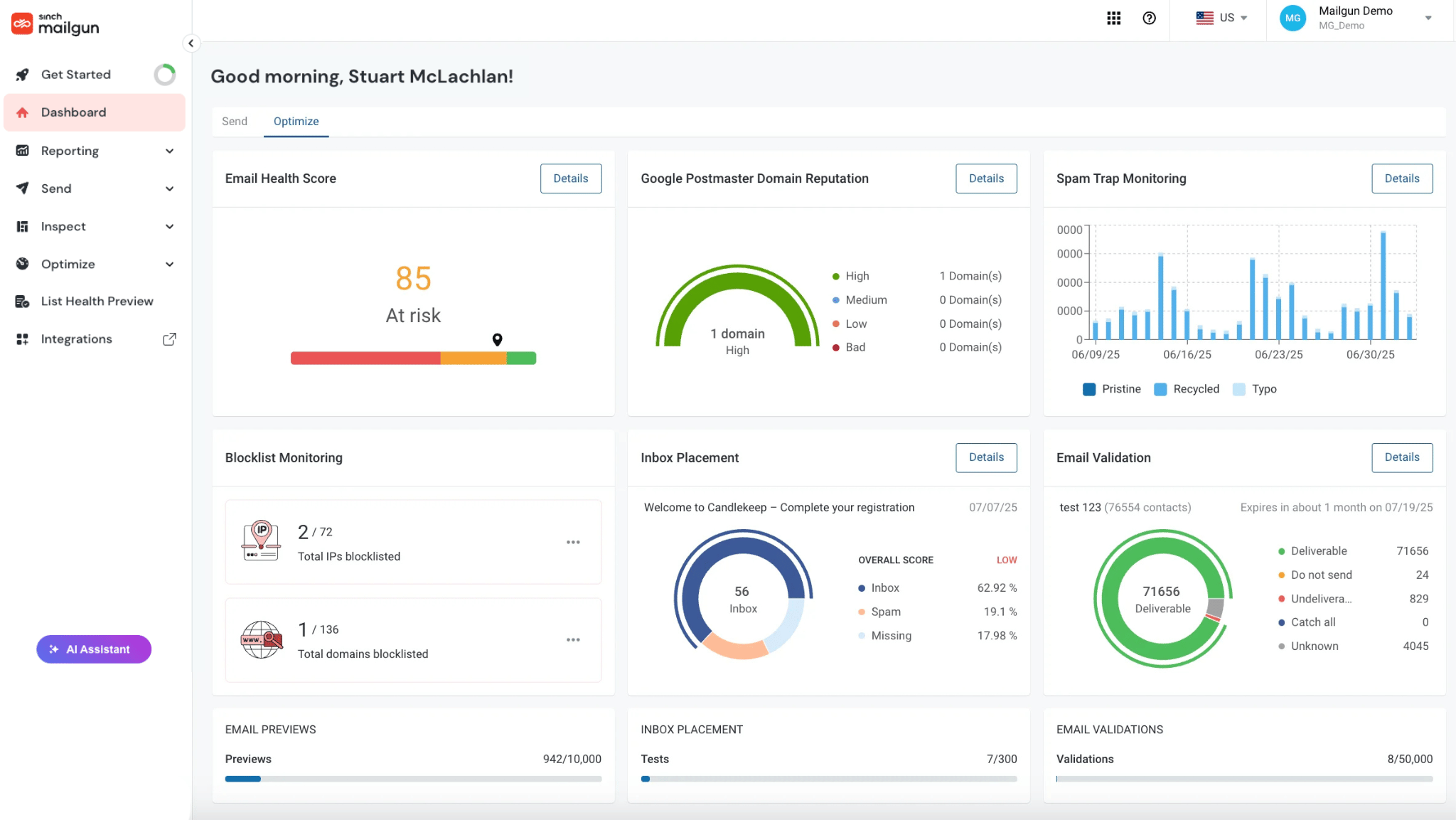
Mailgun is built for developers and engineering teams sending transactional email at scale. Like Mailjet, it is backed by Sinch, and plenty of enterprise companies rely on it for infrastructure. The two are deliberately different: Mailgun is focused on developer-first tooling and email delivery at scale, whereas Mailjet covers marketing and transactional together, supporting businesses as they grow.
Where it earns its place is depth on the sending side. Detailed logs, inbound routing, deliverability tooling, and dedicated IP management all go further than a general-purpose platform manages. If email is infrastructure for your product rather than a marketing channel, it is the more natural fit.
Free tier is 100 emails a day. Paid plans start at $35/month for 50,000 emails and $90/month for 100,000.
ℹ️ Worth knowing
Marketing email is not its territory. There is no campaign builder aimed at marketers, no landing pages, and no forms. A team that needs both sides will end up buying a second tool.
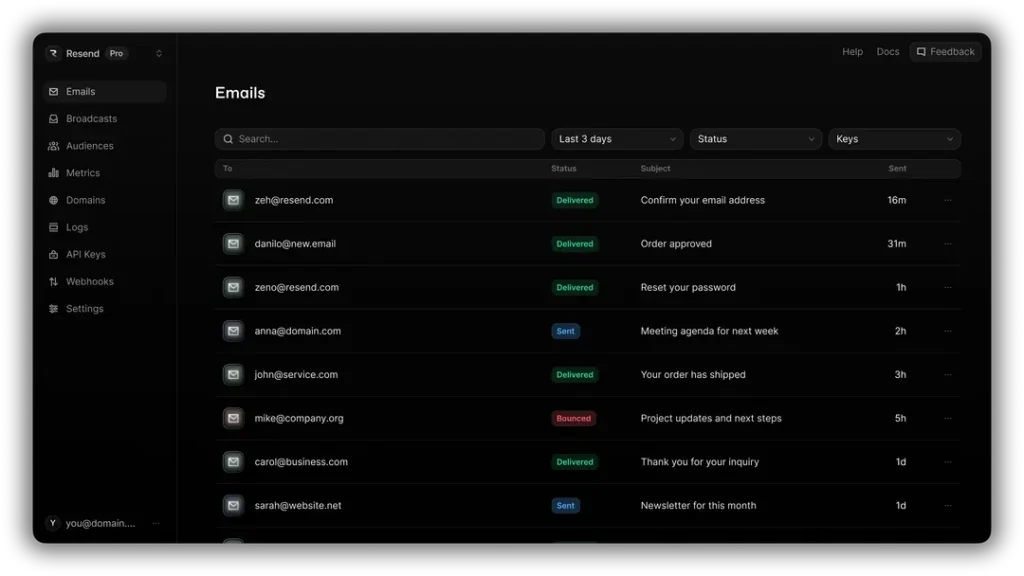
Best for fast technical setup: Resend
Many developers recommend Resend when the subject of leaving SendGrid comes up, and setup speed is usually the reason. It configures DNS records automatically for domains on supported providers, which removes the step that stalls most migrations. Developers report moving a working SendGrid integration across in about an hour.
It is no longer transactional-only. Resend now runs a genuine marketing product: Contact management, broadcast campaigns, a visual editor, segmentation, and automatic unsubscribe handling. It covers more ground than it did a year ago.
Transactional pricing is free up to 3,000 emails a month, then $20/month for 50,000 and $35/month for 100,000. Marketing is priced separately, and on a different basis. Its own pricing page says those plans are “not limited by the number of emails sent.” Contacts are what you pay for. Free covers 1,000 of them, then $40/month for 5,000 and $250/month for 50,000.
ℹ️ Worth knowing
That contact-based model is the same structure many marketers leave SendGrid to escape. If you’re planning on using Resend for both transactional and marketing emails then check both your list size and your send volume.
Resend is also younger than others in the marketing space, with a smaller feature set for marketing teams.
Best for transactional-only senders: Postmark
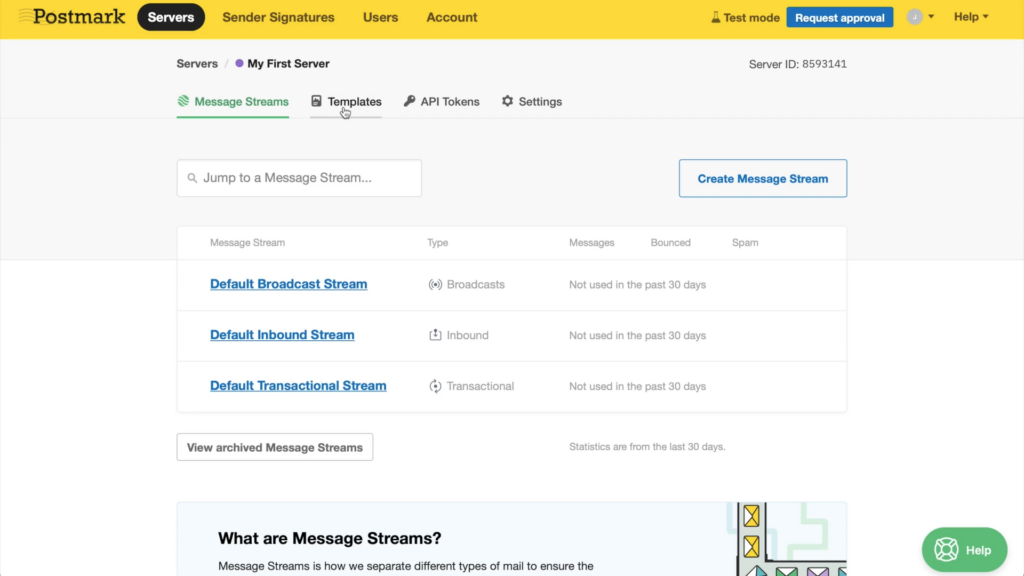
Postmark does one thing – transactional email – and it has a long-standing reputation for doing it quickly. Teams running password resets, receipts, and account notifications rate it highly. Separate message streams keep transactional traffic away from bulk sending, so one cannot damage the reputation of the other.
The tooling is focused rather than broad: Detailed delivery data, webhooks, template management, and inbound processing. There is no marketing side at all, which is rather the point. However, it has been part of ActiveCampaign since 2022, and now trades as ActiveCampaign Postmark. Marketers would need to purchase an ActiveCampaign subscription to meet their needs.
Free tier is 100 emails a month. Paid plans run $55/month for 50,000 emails and $115/month for 125,000.
A CTO reviewing it on G2 sums up both sides: “Top deliverability, top Rails integration, great UI,” with the one drawback that “price has increased.”
ℹ️ Worth knowing
Account approval requires a publicly accessible product, which blocks internal tools and pre-launch projects.
Prices have risen for existing customers over time. If you need marketing email, this is not the platform.
Best for lowest cost at very high volume: Amazon SES
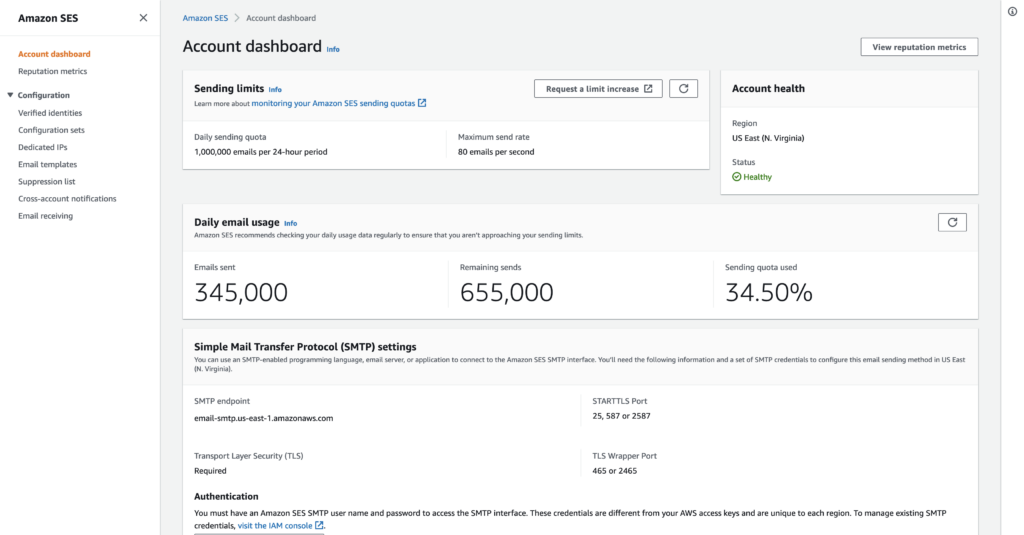
Amazon SES is the cheapest option here at volume, at $0.16 per 1,000 emails on the Essentials plan, and free for the first six months. For teams already running on AWS and sending millions of messages, nothing else competes on unit cost.
That price comes with real engineering cost, because SES is infrastructure rather than a product. There is no template system, so you build your own with something like MJML or Handlebars. Production access needs approval. Bounce and complaint handling means wiring up SNS yourself, and delivery failures are not surfaced for you.
ℹ️ Worth knowing
SES is not suitable for marketers, and it is not somewhere you can run your whole email program.
There is no campaign builder, no segmentation, no automation, and no reporting a marketing team would recognize.
Spam tolerance is deliberately low, so it suits transactional sending and sits badly with marketing email. Every layer above raw sending is yours to build and look after.
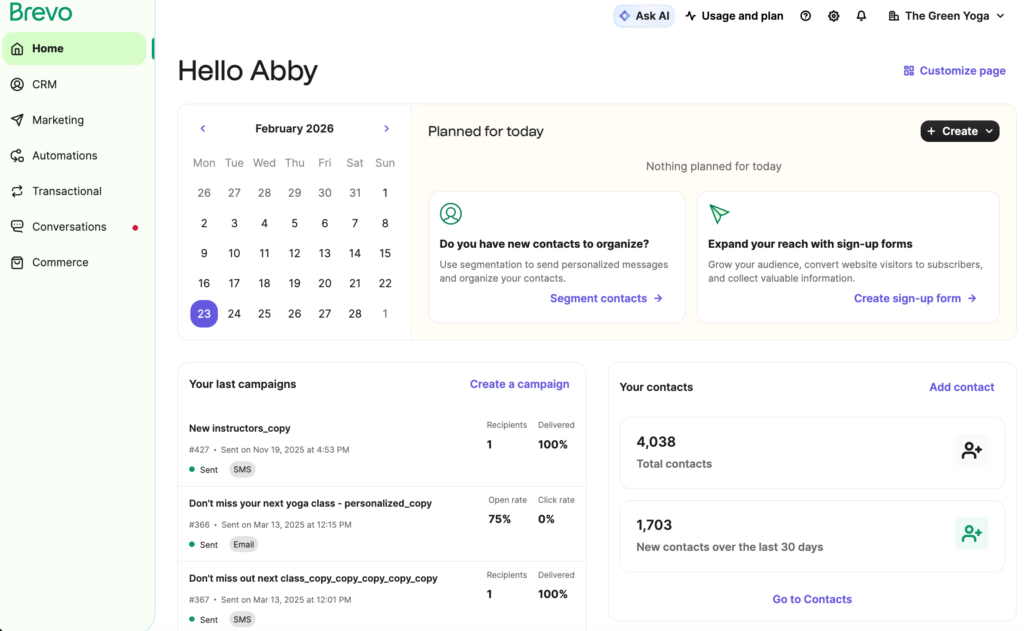
Best for combined marketing and sales tools: Brevo
Brevo bundles email marketing with CRM, SMS, WhatsApp, and chat. For a small team that wants marketing and sales tools on one subscription, that breadth is the appeal. The campaign builder and automation tools are genuinely capable.
It is also French, and stores customer data in the EU, which matters if data residency is a requirement. The free tier is 300 emails a day, with paid plans from around $9 a month. Contact-based limits apply on the lower tiers.
A development strategist at a non-profit titled their Capterra review “Persist through the learning period, it’s (mostly) worth it.” The designer earns real praise. “It’s very easy to build beautiful campaigns with relatively no effort.” The friction sits elsewhere. “Getting Brevo to talk to other apps is practically a nightmare.”
ℹ️ Worth knowing
The breadth cuts both ways. Brevo offers considerably more than most teams need, and it is not an email specialist. The platform can feel complex when email is the only job you came for.
Developers running transactional-heavy setups report that email credits get expensive. And you need to pay extra to remove the Brevo branding from your emails.
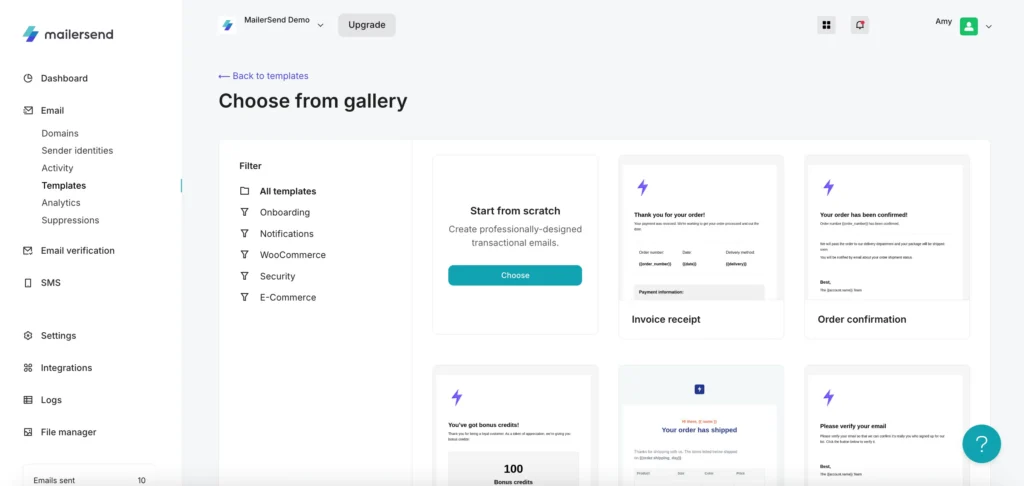
MailerSend covers transactional email with unusually deep developer tooling for a platform of its size. It offers 50 webhooks on its Starter plan against SendGrid’s maximum 5, official SDKs across seven languages, and inbound routing. Automated domain authentication through Entri removes most of the DNS work.
It also runs unlimited sub-accounts on higher plans. That makes it a practical choice for agencies managing sending for several clients from one place.
Free tier is 500 emails a month. Paid plans start at $7/month for 5,000 emails, then $35/month for 50,000.
ℹ️ Worth knowing
There is no marketing campaign product, so this is a transactional platform. Some users report account approval being declined without a clear reason.
These seven email platforms cover a range of capabilities and preferences. But one other factor cuts across all of them, and it decides the shortlist for a lot of teams.
Looking for a European SendGrid alternative
Where your subscriber data is stored is a real constraint, not a technicality. It applies whether you are based in the EU or based elsewhere and holding data on EU customers.
Most of the platforms above are US-headquartered and store data in the US by default. Mailjet hosts data in Europe, is GDPR compliant, and offers privacy-first tracking. It holds ISO 27001 certification. Brevo is also French and stores customer data in the EU, according to its help documentation.
If EU data residency is a requirement rather than a preference, it narrows this list considerably. Check where a platform actually stores data rather than where its company is registered, because the two are not always the same.
How to move away from SendGrid
Migrating is more straightforward than most teams expect, and the order matters.
Export your contacts first. Do this before anything else if your plan is ending, because contact data may not survive the change.
Authenticate your sending domain. Add SPF and DKIM records for the new platform. Some platforms configure DNS automatically on supported providers.
Run both platforms briefly. Point a small share of traffic at the new platform and compare delivery before switching fully.
Warm up gradually if you have a dedicated IP. A new IP with no sending history needs volume built up over days, not hours.
Rebuild templates and webhooks. Template syntax and webhook payloads differ between platforms, so budget time for this.
A few questions come up often enough to answer directly.
Frequently asked questions
No. SendGrid retired its free Email API and free Marketing Campaigns plans in 2025. What remains is a 60 day trial, limited to 100 contacts and 100 emails a day, rather than a permanent free plan.
That depends on what you send and is what this page is here to help you work out! If you only send transactional email, Postmark will serve you well and cost less than a combined platform. For very high volume with engineering resource behind it, Mailgun handles scale and infrastructure, while Amazon SES is cheapest. Teams running marketing campaigns and transactional email side by side get both on one Mailjet plan, without paying for audience size.
Several platforms still offer a permanent free plan. Mailjet gives you 6,000 emails a month with up to 1,000 contacts, and no credit card is required. Resend offers 3,000 emails a month, Brevo 300 a day, MailerSend 500 a month, and Amazon SES is free for the first six months. Check the contact limits as well as the sending limits, because both apply.
Deliverability depends more on your own sending practice than on your provider, so treat any vendor benchmark with caution. What matters is the tooling: Dedicated IP options, reputation and blocklist monitoring, straightforward SPF, DKIM, and DMARC setup, and clear reporting when something fails. Mailgun and Postmark are strong on the transactional side. Mailjet delivers 98% of the emails it sends, publishes deliverability reporting, and offers dedicated IPs on higher plans.
For a straightforward transactional setup, developers report completing a migration in about an hour, helped by automated DNS configuration. A migration involving marketing templates, automations, and a dedicated IP warm-up takes longer, and IP warm-up alone runs over several days.
Choosing your SendGrid alternative
There’s a lot to consider, but we’d always recommend starting with scope rather than price. If you only send transactional email, a specialist platform like Mailgun or Postmark will serve you better and cost less. If you send marketing campaigns as well, the question becomes whether you want one platform or two products.