Marketing
Email in 2026: Strong ROI, rising AI adoption, and a measurement problem nobody’s fixing

Email is not going anywhere. But the distance between email programs that invest in measurement, deliverability, and optimization and those that run on assumptions is getting wider every year.
Sinch Mailgun’s 2026 Email Impact Report draws from a global survey of more than 1,200 email senders and an analysis of over 400 billion real emails sent through Sinch Mailgun infrastructure in 2025. The report spans five chapters covering ROI, industry benchmarks, deliverability, AI adoption, and investment trends.
Here are the findings that matter most for email senders heading into the second half of 2026.
Email ROI is strong. Email ROI measurement is not.
78% of senders say email is “very” or “extremely” important to their organization. That level of buy-in is hard to find for any marketing channel. But organizational belief and organizational evidence are two different things.
Fewer than half of senders actively measure the ROI of their email programs, whether promotional (46%) or transactional (43%). Most teams are operating on conviction rather than evidence.
of senders say they can measure the ROI of promotional emails.
of senders who measure ROI for promotional emails say it is greater than $10 for every $1 spent.
of senders measuring email marketing ROI say their return is more than $40 for every dollar spent.
62% of senders measuring transactional email ROI report the same $10:1 threshold. And 13% report returns above $40:1, though Sinch Mailgun’s research suggests returns that high may signal underinvestment rather than peak efficiency.
The biggest barrier to increased email investment? 43% of senders cite budget constraints. But budget is hard to win without data, and most teams are not collecting the data they need to make the case. The report recommends starting with revenue per campaign as an intermediate step toward full ROI tracking, even if the attribution model is not perfect from the start.
400 billion emails reveal where the benchmarks actually sit
Most benchmark data in the email industry comes from surveys and self-reported estimates. Chapter 2 of the report takes a different approach: real sending data from Sinch Mailgun infrastructure across the top 10 industries by volume in 2025.
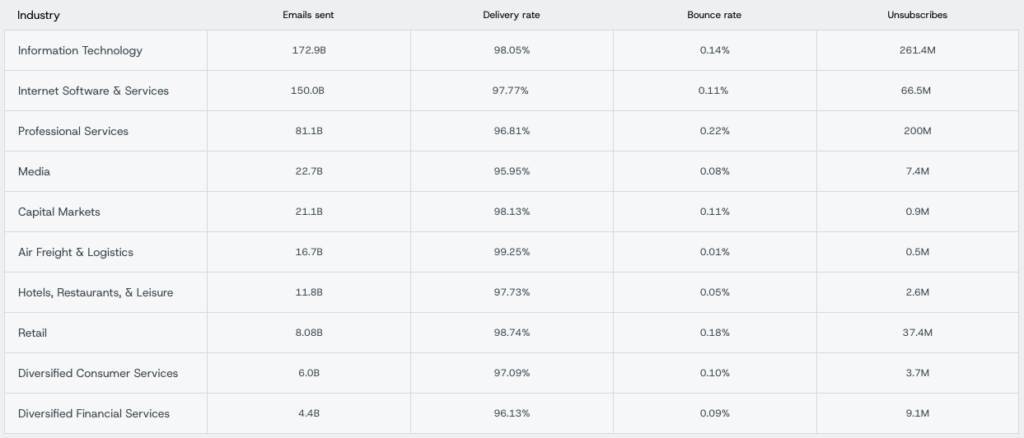
The numbers at the top and bottom of the table tell different stories. Air Freight & Logistics leads with a 99.25% delivery rate and 0.01% bounce rate, driven almost entirely by transactional sends (shipping confirmations, tracking updates) to recipients who expect and want those messages. Media sits at 95.95%, the lowest in the top 10, where high volumes and broad promotional audiences create natural downward pressure on delivery metrics.
But delivery rate alone can mislead. An email “delivered” to the spam folder still counts as delivered. The report makes a clear case that senders should pair delivery rate tracking with inbox placement testing to understand where emails are actually landing, not just whether they were accepted.
One comparison worth flagging: Information Technology logged 261 million unsubscribes, the highest raw number in the table. But across 172.9 billion sends, that’s a rate of roughly 0.15%. Retail generated 37.4 million unsubscribes on just 8.08 billion sends, a far higher rate per email. Raw unsubscribe volume without send volume context is meaningless.
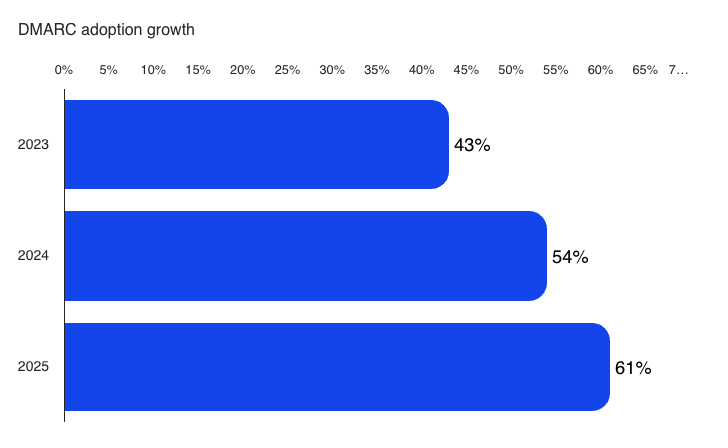
89% of senders say deliverability is important to their organization. 43% say their inbox placement improved in the last 12 months. The infrastructure progress is real: DMARC adoption has grown significantly, driven by requirements from Gmail, Yahoo, and Microsoft. For the first time in Sinch Mailgun’s research, enforcement is outpacing passive monitoring, with over half of DMARC adopters now using quarantine or reject policies.
But the understanding hasn’t kept up. 36% of senders claim to monitor their “email deliverability rate,” a metric that does not exist. The delivery rate measures emails accepted by the server, including those filtered to spam. Inbox placement measures what actually reached the inbox. Only 25% of senders run inbox placement tests to find out, and 27% of DMARC users don’t know what policy they have in place. The tools are improving. The literacy around them is not.
AI adoption is wide. AI impact is uneven.
79% of senders use or plan to use AI in their email programs. But regular use sits at just 27%, and a significant portion of adopters are still experimenting rather than systematically integrating AI into their workflows.
The most common use case is copy generation at 41%, followed by content personalization (36%), dynamic content (29%), send time optimization (27%), and data analysis (27%). The pattern is clear: AI delivers the most value when it is embedded in decision-making, not just content production. Teams using AI for personalization, timing, and testing report compounding returns. Teams using it only to draft subject lines see limited impact.
of senders who’ve implemented AI say their email programs improved moderately or significantly year over year.
of senders who are not using AI saw email program improvements in the same time period
That 17-point gap is the clearest signal yet that AI is beginning to separate email programs by performance tier. It does not prove causation, but the direction is consistent.
23% of AI users say it has not helped them at all. The difference between those seeing value and those not is not the tool. It is the depth of integration.
Where email investment is heading
“Taking advantage of AI” and “increasing email engagement” are tied as the top priorities for 2026, each cited by 40% of senders.
plan to increase their email investment
plan to maintain current spending
plan to decrease their email investment
The report’s conclusion is straightforward: email works. The data supports that across ROI, benchmarks, and deliverability trends. But the programs that will pull ahead are those investing in three areas simultaneously: measurement (proving ROI with real data), deliverability (consistently reaching the inbox through authentication, hygiene, and monitoring), and optimization (using AI and testing to improve performance at scale).
None of these requires a massive budget to start. All of them compound over time.